OPENING | March 27, 2021 | 10 a.m.–2 p.m.
March 27–April 24, 2021
The artist will be present!
The monkey is the creature closest to us humans in terms of ancestry and behavior. “Monkey-like” does not describe something fundamentally inhuman, but rather an over-the-top interpretation of what is expected (for example, in clothing or posture). Monkeys certainly exhibit human traits—such as the ability to learn independently, to engage with their physical and social environment in accordance with their instincts, and to follow established rules—and thus a relationship between nature and culture that is not fundamentally foreign to us, but merely balanced somewhat differently. In the poetic imagination, the monkey therefore readily ascends to a form of humanity that, in Franz Kafka’s “Report to an Academy,” has more trouble with social conventions than with taming its own wildness—which, as recently seen in Haruki Murakami’s story “Confessions of the Shinagawa Monkey,” also presents him with socialization problems that are almost more pronounced among his own kind than in human society. In both cases, the monkey addresses humans in their own language; yet in the little more than a century that has passed, he has evolved from a creature quoted before the distinguished gentlemen of the academy into a conversation partner on equal footing, thereby becoming —perhaps unintentionally—a testament to the prospects of success through intelligent and patient education, although a return to a completely natural state is not up for debate in either Kafka’s or Murakami’s work.
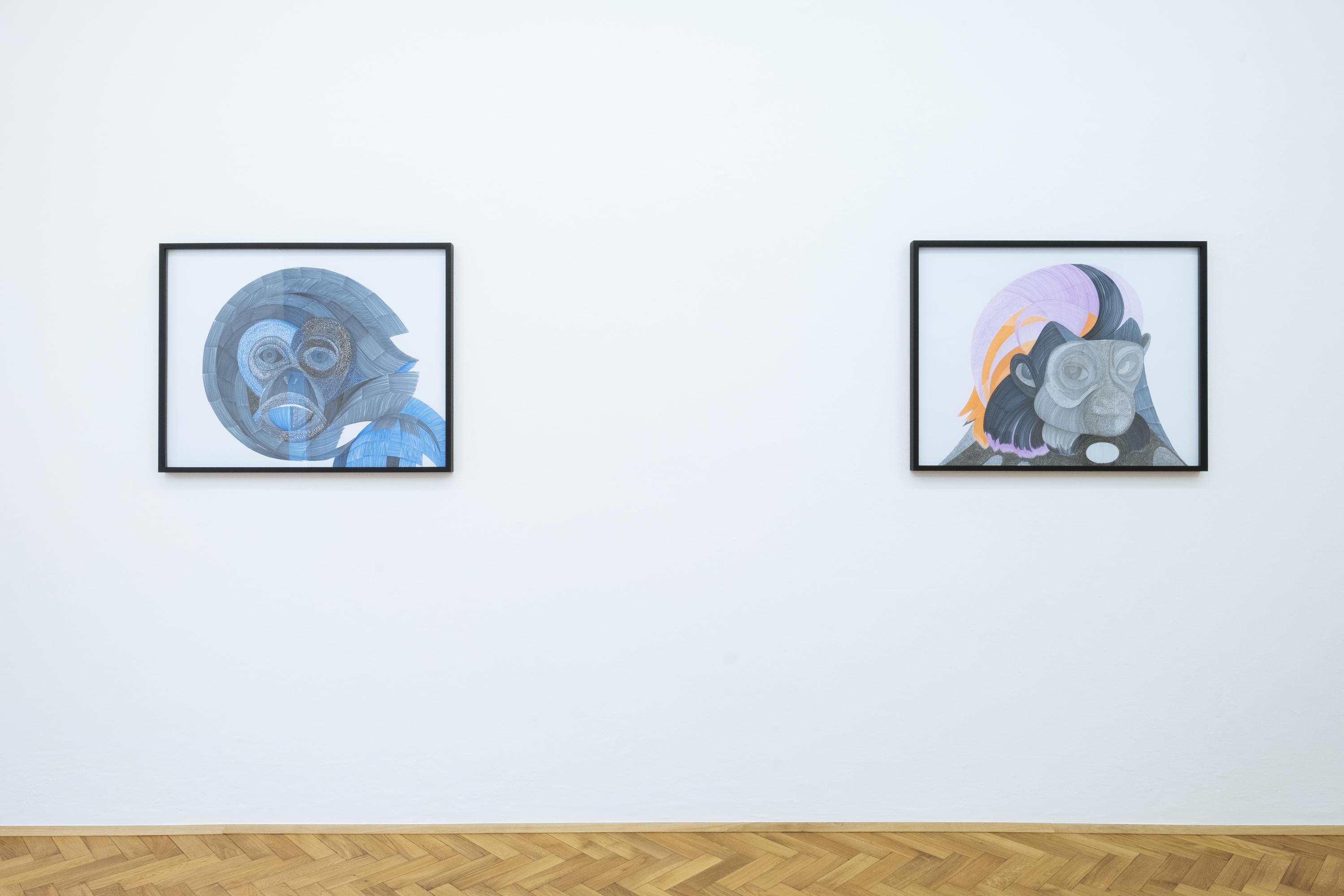
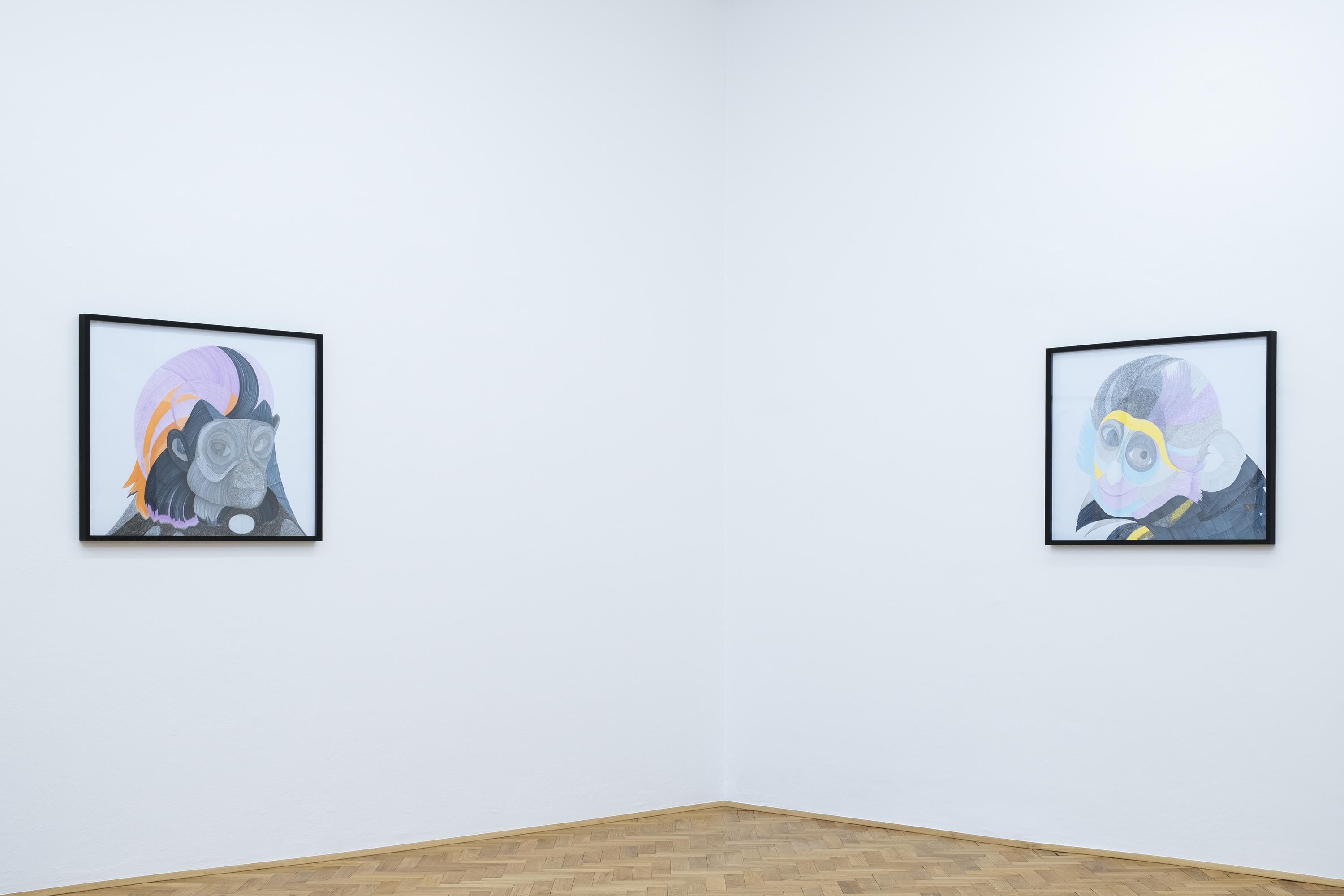
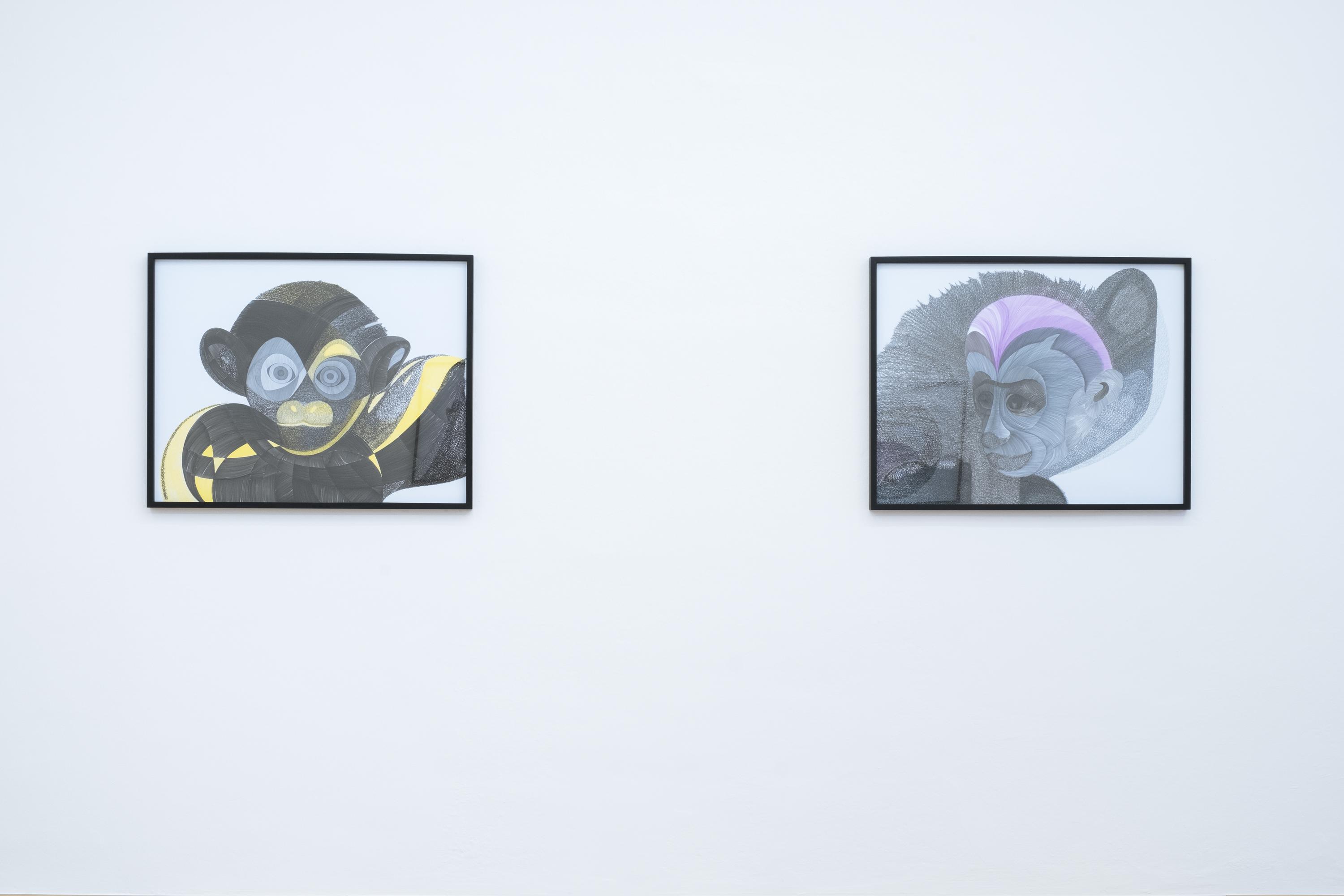
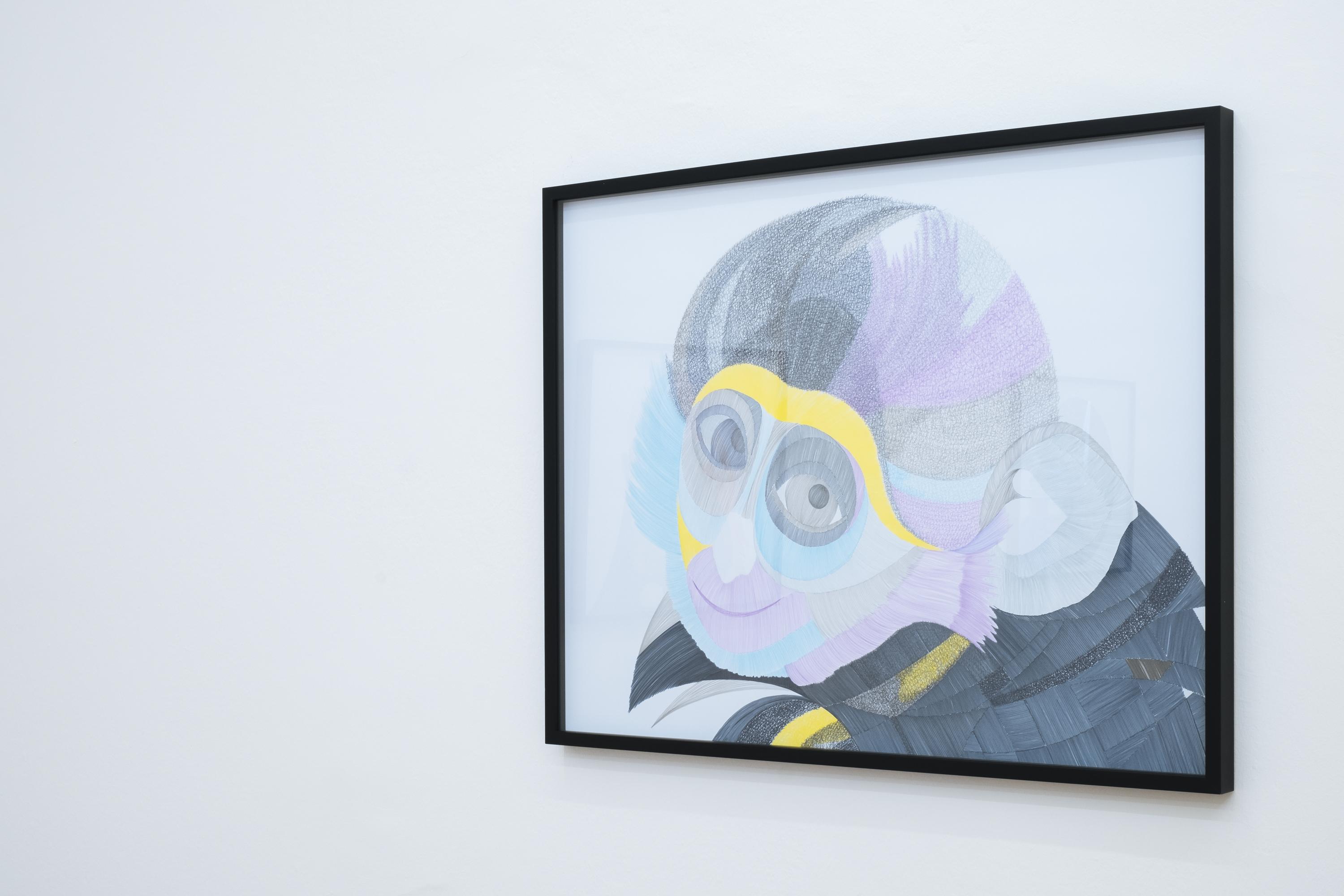
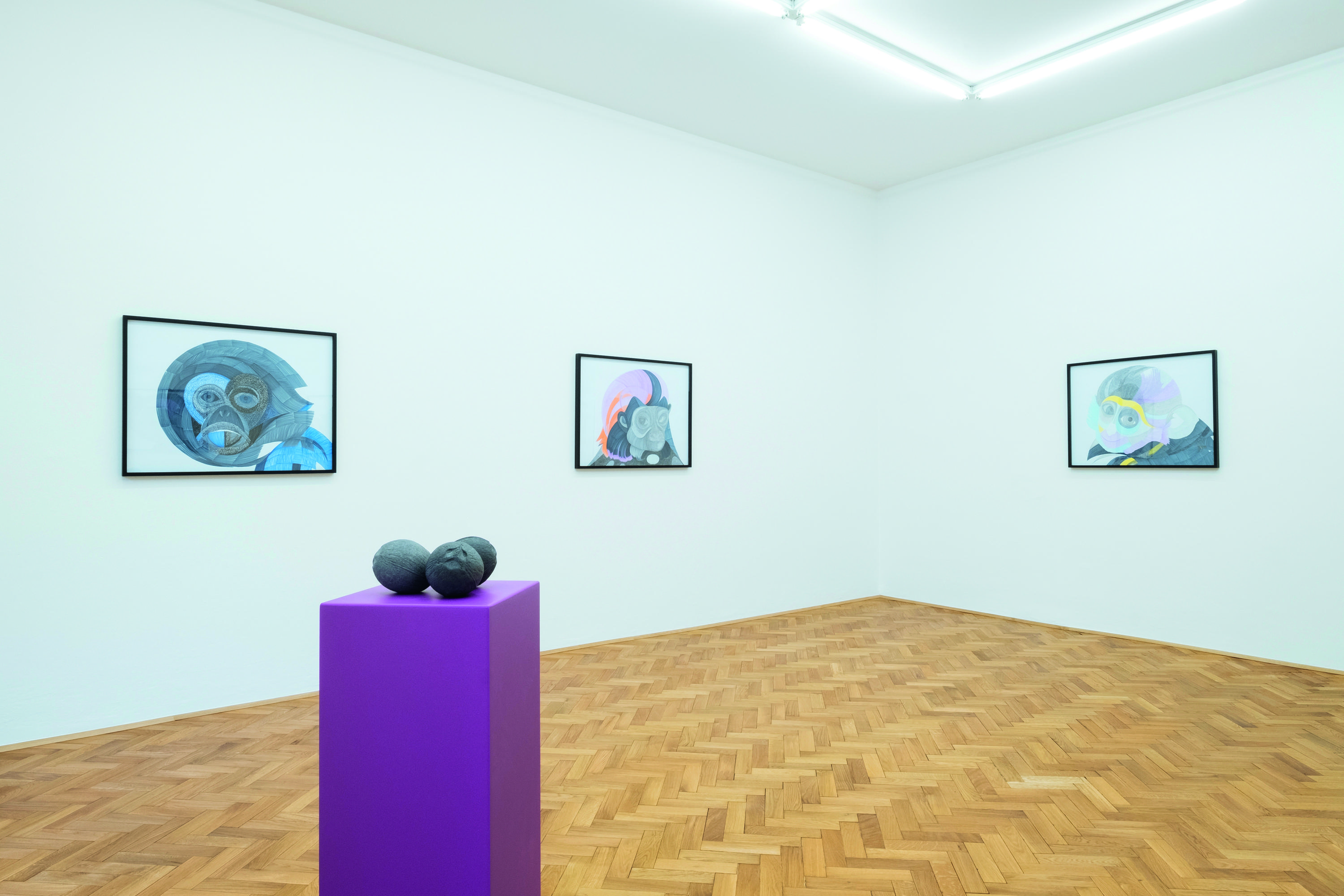
The image of the monkey becomes far more plausible in Veronika Hauer’s drawings. Compared to their appearances in the exhibition “My Summer is your Winter” (Grazer Kunstverein, 2019), the monkeys are now less garish in color and demeanor, and also less impetuous and out of the ordinary. Nevertheless, they remain uncanny, not easily predictable, quite inscrutable, and detached. They embody the humanity and wildness of the monkey through the interplay of hieratic austerity or melancholic detachment—qualities preserved in their gazes—with a far more exuberant dynamism surrounding them. This is mirrored by a drawing style that is itself dichotomous, allowing two logics to interlock. It intertwines a scribbling that stays on the spot—resulting in a line that dances in a grid-like structure without ever breaking free of its form, yet remains thoroughly exuberant within its boundaries—with a far more erratic, energetic sweep that simultaneously models the furry body in parallel arcs. Down to its microstructure, the drawing of the monkeys preserves what defines their character as a tension between “culture” and “nature”—and, as an interplay of script and event or of language and expression, has always been one of the fundamental problems of performative settings, which Hauer addresses throughout her body of work in varying formats but with consistent clarity. Through the monkey, Hauer addresses the prototype of the fool, the performer. She holds it up before us as a model, giving us a vague idea of how—in handling the coconut casts—whose parting seems to resemble a monkey’s face and which make soft noises when moved—we might gain a little of the fool’s freedom.
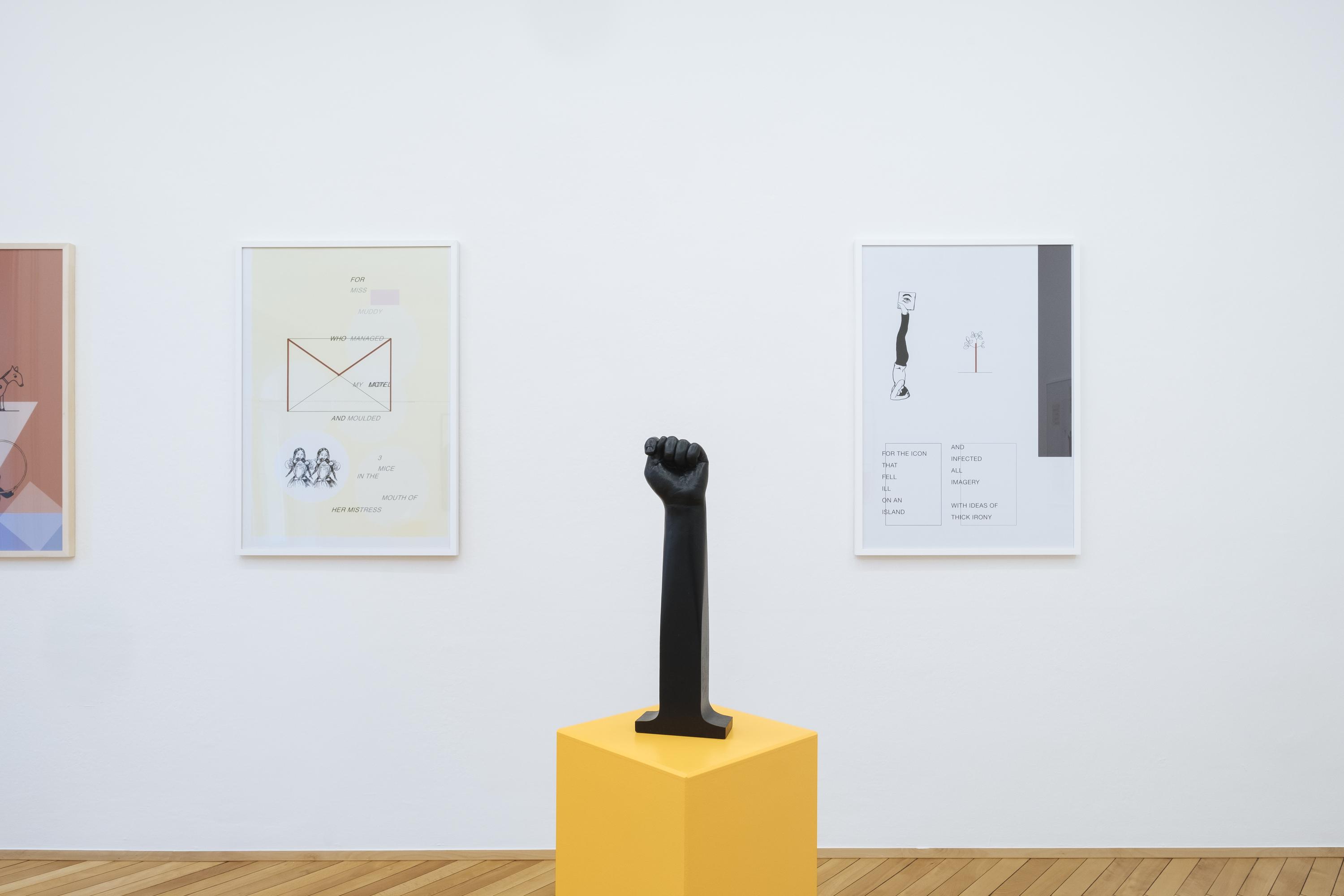
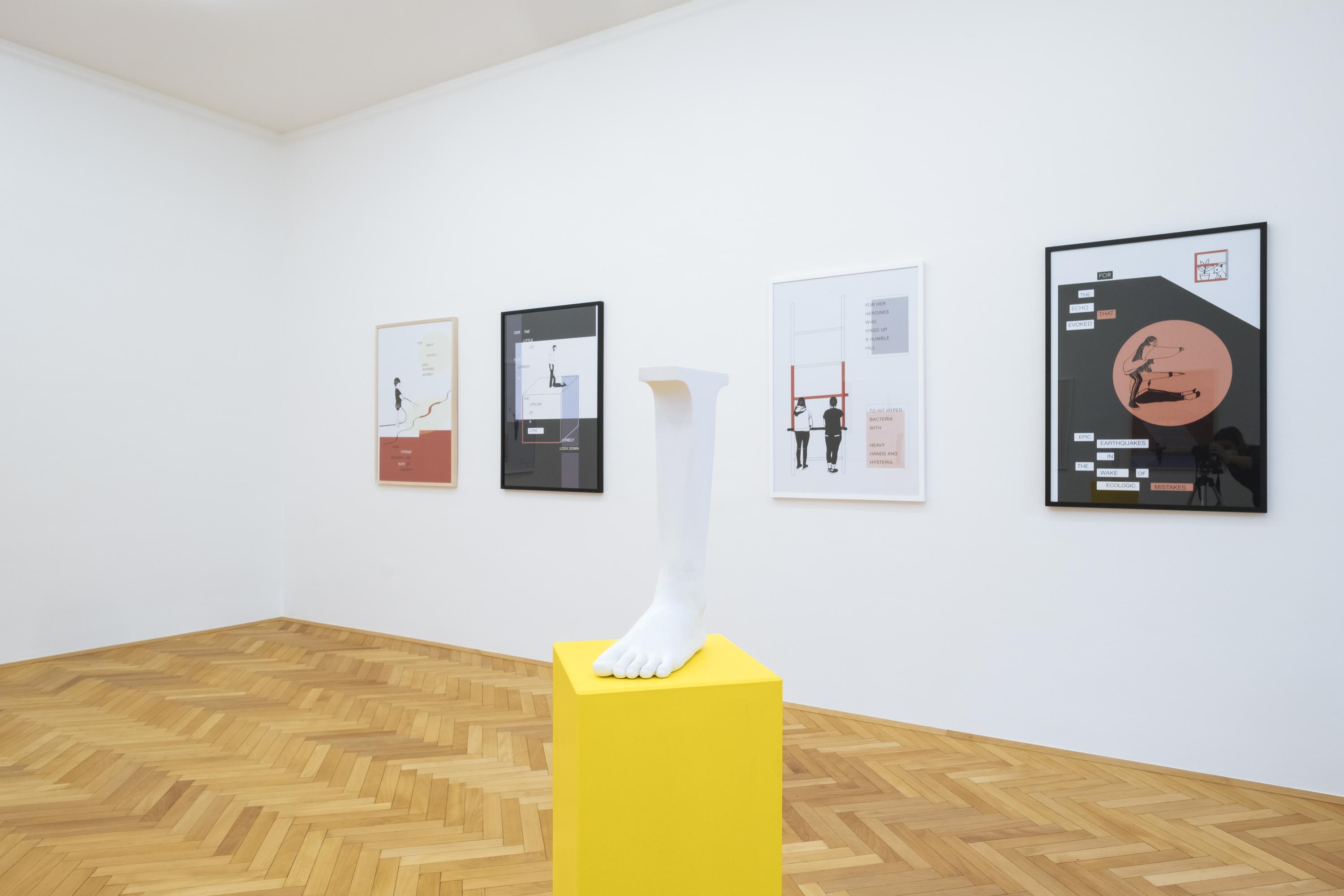
To balance the differences evoked in the monkey portraits, it is practically obvious to to follow impulses from educational contexts—that is, to find inspiration and borrow ideas from areas where methods are perhaps most clearly geared toward balancing coercion and freedom, even if the goal, as with language acquisition (which has likely caused more problems for some people than for the monkeys in Kafka and Murakami), lies in a transition into flesh and blood, as demonstrated by Hauer’s objects “L (left)” and “I” in the fusion of letters and legs, or rather the two modes—abstraction and empathy, originally (in Wilhelm Worringer’s work) understood as opposites.
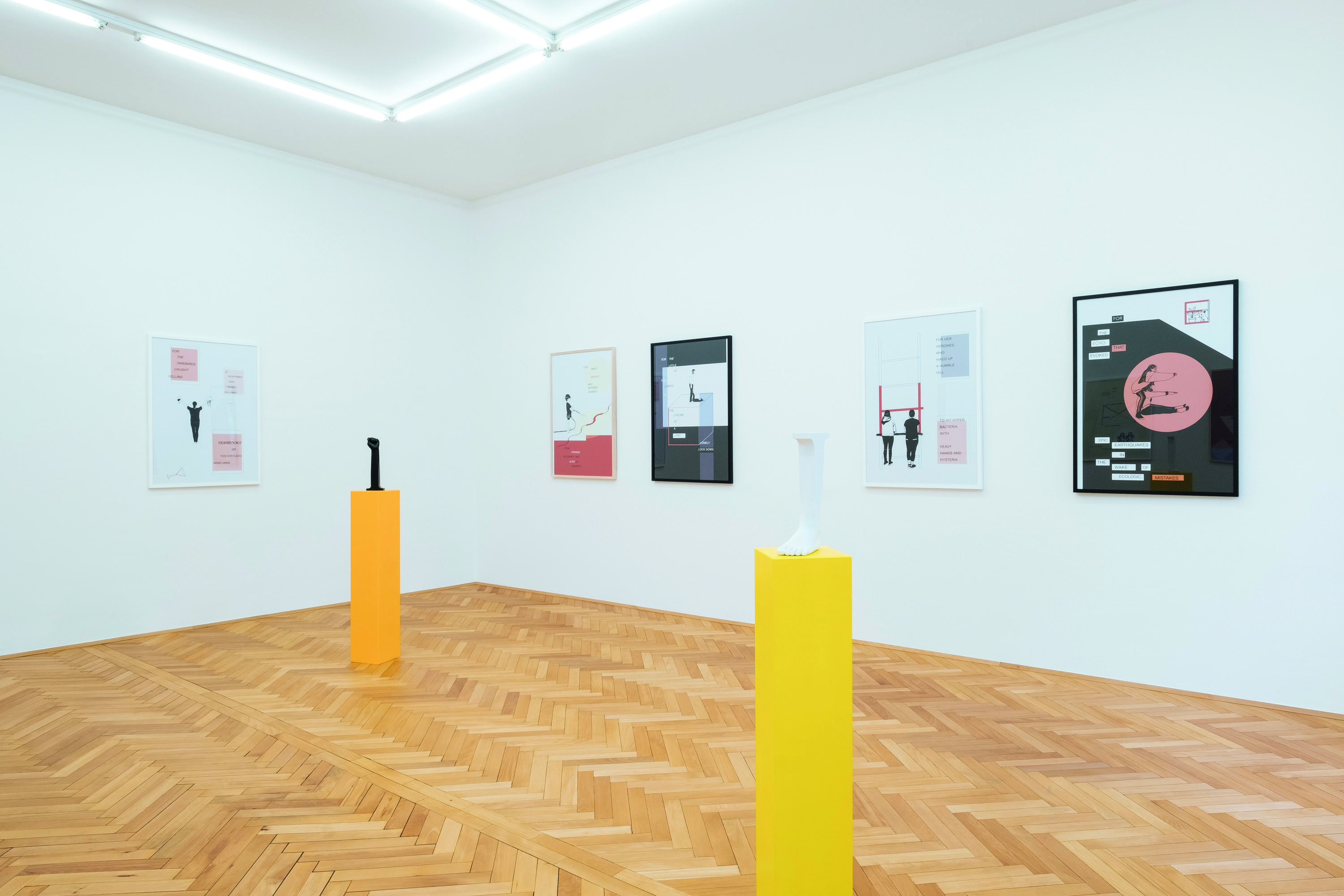
In her prints, Hauer draws on three ABC primers, whose didactic purpose lies in conveying precise codes and, once internalized, in enabling free linguistic expression. From time immemorial, these primers have guided perceptions, ideas, and interpretations through chains of association—for example, to recognize the shapes of letters in the outlines of bodies or objects—a process that succeeds all the more easily when the visual language employed follows a purist, objective pictogram style, as in the play primer “Hurra, wir lesen! Hurra, wir schreiben!” (1930) by the painter, illustrator, and children’s book author Tom Seidmann Freud (born Martha-Gertrud Freud and niece of the father of psychoanalysis).
In these primers, however, chains of association also form words linked by alliteration and/or rhyme. In Hauer’s work, they lead to imaginative worlds that are by no means childlike or harmless, whose absurdity finds a model in Walter Crane’s The Absurd ABC (1876). This evokes an early example of using amusement to mitigate the side effects of didactic overzealousness, even if a missionary attitude may still lurk behind the linguistic melody thus brought to the fore. As early as 1862, Wilhelm Busch pursued similar goals with his “A-B-C Book for the Animal Kingdom”: “The anthill is teeming / The monkey never eats anything moldy.” The free interplay of sense and nonsense then provides a poetic counterpoint to the educational balancing act between constraint and freedom.
The kinship between pedagogy and performance art is perhaps most evident in those primers that inscribe the letters into a pose, such as W. T. Crane’s “An Animated Alphabet” (1861), where letters become legible through playful yet quite absurd manipulations of various props. Hauer had some of the poses—drawn with Victorian staidness—reenacted by adults; she then captured these reenactments in drawings, thereby stripping them not only of their frilly, musty air. Combined with the adult language of the poetic alliterations, they become images whose target audience is not necessarily children and whose goal is not necessarily literacy.
Just as in the juxtaposition of an image of a monkey and a coconut, Hauer also delineates spaces for possible actions by interweaving different ABC primers. She provides models and props for playful action, offers and explores legibility, and describes situations—all without, however, providing concrete answers or stage directions, or even underpinning a specific action with a concretely comprehensible content. The meaning of the constellations thus evoked remains didactic only insofar as it seems to suggest how enjoyable it can be to break away from what might elsewhere be determined by practical necessity. As in the recontextualization of the semaphore alphabet used in shipping as “Semaphore Dance” (2014), poetry can certainly be derived from a shift in purpose.
Ulrich Tragatschnig